You just finished a whitening treatment, checked the mirror, and noticed small white patches that were not there before (or that suddenly look much brighter than the rest of your smile).
It is a common moment of worry, and a fair one.
White spots after teeth whitening may become more noticeable because of temporary dehydration or differences already present in the enamel. Spots that persist or come with pain should be checked by a dentist.
Some spots are different. They may point to mineral loss, early decay, or enamel that formed unevenly years ago and simply became more visible once the surrounding teeth lightened.
Professional teeth whitening can brighten natural teeth, while an assessment beforehand helps identify enamel differences that may affect the result.
The path forward depends on what kind of spot you are looking at, not on guesswork. Pausing whitening, giving your teeth a few days, and watching how the spots behave will tell you a lot.
If anything changes, grows, or hurts, that is your signal to get a professional opinion instead of waiting it out.
Key Takeaways
- Temporary dehydration can make white spots more noticeable, but persistent spots may have another cause.
- Spots that persist, grow, or come with tooth pain need a dental exam rather than home guesses.
- Treatment options range from fluoride and remineralizing toothpaste to microabrasion, resin infiltration, bonding, or veneers, chosen based on the actual cause.
Table of Content
- Why Do White Spots Look More Noticeable After Whitening?
- What Should You Do When You Notice White Spots?
- When Should a Dentist Check the Spots?
- How Can Persistent White Spots Be Treated?
- How Can You Lower the Chance of Patchy Results Next Time?
- Let the Cause Guide Your Next Step
- Frequently Asked Questions
Why Do White Spots Look More Noticeable After Whitening?
White spots usually become more visible after whitening because the enamel around them changes shade while the spot itself does not whiten the same way.
Some of these marks were always there; others are a normal, short-term reaction to the whitening process itself.
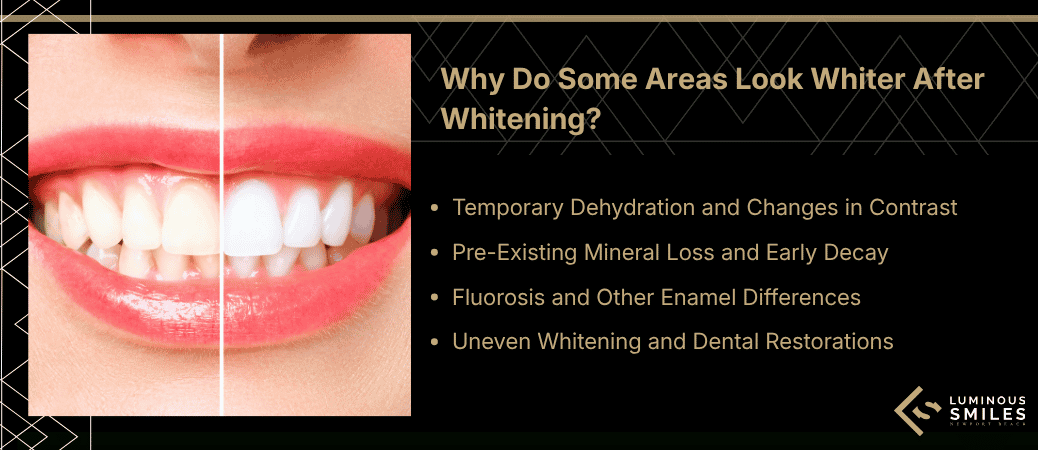
Temporary Dehydration and Changes in Contrast
Whitening gels pull moisture out of enamel for a short time, and dehydrated enamel looks chalkier and lighter than normal.
This creates enamel dehydration spots that can appear right after you remove whitening strips or finish an in-office session.
As saliva rehydrates the tooth over the following days, these spots usually blend back into the surrounding enamel.
Hydrogen peroxide and carbamide peroxide, the two active ingredients used in most whitening products, work by breaking apart stain compounds within the tooth.
Dehydration can temporarily change how enamel reflects light, making existing white areas look more noticeable.
Pre-Existing Mineral Loss and Early Decay
Some white spots were on your teeth before you ever started whitening, caused by enamel mineral loss from acid exposure over time.
The National Institute of Dental and Craniofacial Research explains that repeated acid attacks pull minerals out of enamel and can leave behind an early sign of decay before a cavity ever forms.
At this early stage, minerals from saliva and fluoride can still help rebuild the enamel.
Plaque buildup is often the root cause. Bacteria in plaque produce acid that strips calcium from enamel, leaving chalky patches known as white spot lesions.
Fluorosis and Other Enamel Differences
Dental fluorosis happens when a child gets more fluoride than needed while adult teeth are still forming under the gums, leaving faint white lines or flecks once those teeth erupt.
This is permanent and unrelated to anything you did recently.
Hypomineralization and hypocalcification describe similar enamel differences, where certain areas of a tooth formed with less mineral density than the rest, creating a visible contrast once whitening lightens everything around them.
Uneven Whitening and Dental Restorations
Crowns, veneers, and fillings do not respond to whitening gel the way natural enamel does, so they can stand out once your natural teeth lighten.
The American Dental Association notes that whitening can make existing white marks from fluorosis or braces stand out less against brighter enamel, though results vary from person to person.
Uneven whitening across natural teeth can also happen when gel coverage was inconsistent during application.
What Should You Do When You Notice White Spots?
Pause future whitening sessions and give your enamel time to recover before judging the result.
Most dehydration-related white marks on teeth after whitening settle down within a few days to about a week, so patience is the first and most useful step.
Pause Whitening and Give Your Teeth Time to Rehydrate
Hold off on additional whitening treatments while you watch the spots. Rehydration happens naturally as saliva flows over your teeth throughout the day, so there is nothing special you need to apply to speed up the process.
Avoid stacking another round of strips or trays on top of teeth that are still adjusting.
If you notice tooth sensitivity along with the spots, that is worth tracking too. Sensitivity that fades within a few days is common after whitening; sensitivity that lingers or worsens deserves attention.
Care for Your Enamel Without Scrubbing or Bleaching Again
Keep your oral hygiene routine gentle and consistent rather than aggressive. Brushing harder or scrubbing at a white spot will not make it fade faster and can irritate your gums.
Switch to a fluoride toothpaste or a remineralizing toothpaste formulated with hydroxyapatite, which supports enamel health by helping redeposit minerals into weakened areas.
Brush twice daily, floss, and limit sugary or acidic foods while you wait to see how the spots evolve.
This also happens to be sound daily practice for anyone who wants to keep their results looking even; a few tips on how to whiten teeth safely can help you build habits that protect your enamel long term.
When Should a Dentist Check the Spots?
See a dentist if white spots stay the same, grow, or change in texture, or if you notice any tooth pain.
A visual check at home cannot tell you whether a spot is harmless dehydration, old fluorosis, or active decay, and that distinction matters for what happens next.
Signs That Need an Examination
Book an appointment if you notice any of the following:
- The spot has not faded after a week or two
- The area feels rough, soft, or different in texture from the rest of the tooth
- You have new or ongoing tooth sensitivity
- The spot is getting larger or darker at the edges
- Pain develops when you eat something hot, cold, or sweet
A dentist can also check for cavities forming near the spot, especially if it sits in a hard-to-clean area like along the gumline or between teeth.
Why Appearance Alone Cannot Identify the Cause
A white spot can look identical whether it comes from fluorosis, dehydration, or early decay, which is exactly why guessing at home is not reliable.
White spot lesions, fluorosis marks, and dehydration spots can share a similar chalky, opaque look even though their causes and next steps are completely different.
Your dentist uses tools like a dental exam and sometimes imaging to tell them apart, rather than relying on how the spot appears to the eye.
How Can Persistent White Spots Be Treated?
Treatment depends entirely on what is causing the spot, so there is no single fix that works for every case.
A dentist matches the approach to the diagnosis, which might mean strengthening the enamel, polishing the surface, or covering the area with a restoration.
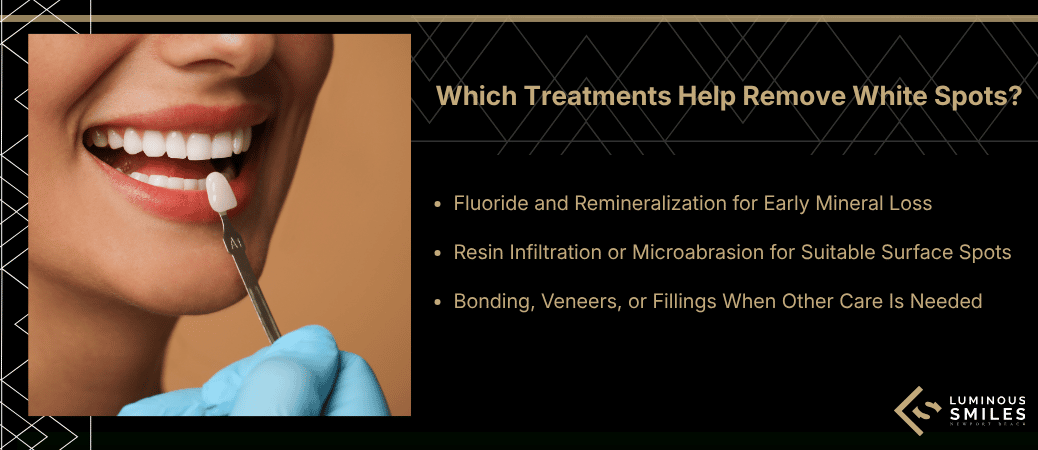
Fluoride and Remineralization for Early Mineral Loss
If a spot is early decay caught before it becomes a cavity, fluoride treatment can help the enamel rebuild lost minerals.
This remineralization process works best in the early stages, before the enamel surface breaks down into an actual cavity. If the damage has already progressed that far, a filling is usually needed instead.
Resin Infiltration or Microabrasion for Suitable Surface Spots
For spots confined to the outer enamel, such as some fluorosis marks or white spot lesions, two minimally invasive options exist.
Microabrasion removes a very thin layer of enamel using a mild abrasive, which can blend a surface spot into the surrounding tooth.
Resin infiltration works differently: a resin is applied to fill in the porous areas of a white spot lesion, which can mask its appearance.
A 2024 systematic review found mixed evidence on whether bleaching itself helps or worsens the look of white spot lesions, so a dentist weighs this carefully before recommending whitening again around an existing spot.
Bonding, Veneers, or Fillings When Other Care Is Needed
When a spot is deeper, part of a restoration, or tied to actual tooth decay, more complete coverage may be the better route.
Composite bonding can cover a stubborn spot with tooth-colored material. Veneers offer a longer-term cosmetic solution for teeth with more extensive discoloration.
If decay has reached the point of a cavity, a filling is the standard repair.
Anyone weighing veneers as part of a broader smile plan might find it useful to look at exploring dental veneers for your smile alongside a dentist’s recommendation.
How Can You Lower the Chance of Patchy Results Next Time?
Getting existing spots checked before you whiten again is the single most useful step you can take.
Patchy results often trace back to enamel differences that were present before treatment started, not to anything that happens during the whitening itself.
Have Existing Spots and Plaque Checked Before Whitening
Ask your dentist to look over your teeth and clear away plaque buildup before your next whitening session.
A cleaning removes the sticky film that can mask or distort how your enamel responds to gel, and it gives your dentist a chance to flag any spots worth monitoring first.
If a spot turns out to be early decay, treating it before whitening prevents a confusing, uneven result later.
Follow Whitening Directions and Protect Daily Enamel Health
Stick closely to the instructions for whichever whitening method you use, since overuse or inconsistent application can contribute to uneven color.
Keep brushing with fluoride toothpaste, flossing daily, and scheduling regular checkups to protect your enamel health between treatments.
If you are deciding how often to repeat whitening, a guide on how often you should whiten your teeth can help you avoid overdoing it.
Reviewing a comprehensive guide to teeth whitening before your next round is also a reasonable way to set realistic expectations.
Let the Cause Guide Your Next Step
White spots after whitening are common, and most of them are nothing to panic about.
Dehydration spots fade on their own within days, while spots tied to fluorosis, old mineral loss, or decay need a different kind of attention.
The smartest move is to pause, observe, and let a dentist examine anything that persists, changes, or hurts. Guessing from the mirror cannot tell you what a professional exam can.
At Luminous Smiles, Dr. Dimple Desai can assess persistent white spots and discuss care based on their cause.
Frequently Asked Questions
Do white spots on teeth after whitening go away?
Dehydration-related white spots on teeth after whitening usually fade on their own within a few days to about a week as your enamel rehydrates.
Spots caused by fluorosis or developmental enamel differences may remain visible. Early mineral loss may respond to remineralization, although the white appearance can persist.
A dental exam is the only reliable way to know which type you are dealing with.
How long do white spots last after whitening strips?
Dehydration spots from whitening strips typically fade within a few days to one week once saliva rehydrates the enamel.
If a spot is still visible after two weeks, it is more likely tied to a pre-existing condition like fluorosis or early mineral loss rather than simple dehydration. Have it checked if it lingers that long.
How can I rehydrate my teeth after whitening?
Your enamel rehydrates naturally through normal saliva flow, so no special product is needed to speed up the process.
Staying hydrated, avoiding another whitening session too soon, and sticking to gentle oral hygiene gives your teeth the best chance to settle back to their usual appearance.
Most people see the dehydration effect resolve within about a week.
Can I whiten again to fix patchy teeth?
Whitening again is not a reliable fix for patchy results, especially if the uneven color comes from fluorosis, old mineral loss, or restorations that do not whiten like natural enamel.
Research reviewing bleaching’s effect on white spot lesions has found mixed results, so more whitening will not necessarily even things out. Ask a dentist to check the cause before repeating treatment.
What toothpaste helps with white spots after whitening?
A fluoride toothpaste or a remineralizing toothpaste containing hydroxyapatite can support enamel health while you wait to see how a spot behaves.
These products help the enamel hold onto minerals rather than reversing fluorosis or filling in a deep lesion on their own. Pair daily brushing with regular dental checkups for the best results.