
Composite bonding can improve tooth shape and repair small chips, but its finished edges should allow comfortable cleaning.
If floss repeatedly catches in the same place, ask your dentist to check the area rather than forcing the floss or trying to smooth it yourself.
That said, a snag that keeps happening in the exact same spot, or one that shows up suddenly after months of smooth flossing, is worth paying attention to.
It can point to a rough edge, a small overhang, or early wear that a dentist can smooth in a short appointment.
At Luminous Smiles, this is one of the most frequent concerns patients raise after bonding, and most of the time it has a quick fix.
This guide walks through why floss catches around composite bonding, how to tell normal texture from a developing problem, and how to clean around bonded teeth without forcing anything.
Key Takeaways
- Repeated floss catching can indicate a rough margin, excess material, or damage that needs checking.
- A snag that repeats in the same spot, shreds floss, or shows up suddenly deserves a dental check rather than home fixes.
- Gentle technique, waxed floss, or interdental tools can keep cleaning effective while you wait for or arrange a review.
Table of Content
- What Causes a Rough Edge or Floss Snag?
- Is This Normal After Treatment or a Sign of a Problem?
- How Can You Clean Between Bonded Teeth Safely?
- When Should a Dentist Check the Bonding?
- Keep Flossing Gentle and Have Persistent Snags Checked
- Frequently Asked Questions
What Causes a Rough Edge or Floss Snag?
Floss usually catches where composite resin meets your natural enamel, because the two materials don’t always blend into one perfectly smooth surface.
Tooth contour changes from the bonding itself can also send floss along a slightly different path than it used to travel.
Where Can Floss Catch at the Bonding Margins?
The bonding margin, where composite resin joins your natural tooth, is the spot floss snags on most.
Even with careful shaping and polishing, this junction can hold microscopic ridges that are invisible to the eye but easy for floss fibers to catch on.
Excess material left slightly past the edge of the treatment area can create a small overhang.
This is harder to notice by looking in a mirror than it is to feel with floss or a fingernail run gently along the gumline.
How Do Tooth Contour and Surface Roughness Affect Floss?
Changed tooth contour after bonding can shift how floss travels between your teeth.
If bonding altered the contact point between two teeth, floss may now follow a new route where it never used to pass, and that new path can run straight into a rough patch.
Composite bonding texture also differs from natural enamel in subtle ways.
The material is applied and shaped by hand, so even expertly finished bonding can carry fine surface variation that enamel, built by nature over years, doesn’t have.
Why Might Bonding Start Catching Floss Later?
Rough composite bonding can develop well after your initial treatment, even if flossing felt smooth for months. Ordinary wear from biting, grinding, or acidic foods and drinks can roughen the surface gradually.
A chip, a worn edge, or gum changes around the restoration can all create a new catch point that wasn’t there before.
This kind of change calls for a different response than day-one roughness, which is covered next.
Is This Normal After Treatment or a Sign of a Problem?
New bonding may feel unfamiliar because your tooth’s shape has changed. However, repeated floss catching, shredding, or a sharp edge should be checked rather than dismissed as an adjustment period.
What Might Feel Different with New Bonding?
Your tongue is remarkably sensitive to new shapes, and it will find and re-check any change in contour for the first week or two.
That heightened awareness, plus some genuine fine texture from finishing and polishing, both settle down as you adjust to your bonded teeth.
Mild sensitivity to cold can tag along during this period too. None of this on its own points to a problem with your bonding treatment.
Understanding what composite bonding involves can help you distinguish a new tooth shape from an edge that needs adjustment.
Which Changes Suggest a Chip, Overhang, or Loose Edge?
A snag that shreds floss in the same exact spot every time is different from general new-bonding awareness.
So is a sharp edge you can feel with your tongue, a piece that looks chipped, or a gum that’s suddenly red or bleeding only next to one bonded tooth.
Food that keeps packing into the same space, or bonding that feels loose compared to how it felt right after treatment, both warrant a look from your dentist rather than a wait-and-see approach.
Floss repeatedly shreds in the same spot. Schedule a dental review to identify the cause.
How Can You Clean Between Bonded Teeth Safely?
Gentle, consistent flossing protects both your gums and your bonded restorations, so the goal is adjusting your technique and tools rather than skipping interdental cleaning altogether.
Waxed floss, floss picks, interdental brushes, and water flossers all have a role depending on where the snag sits and how stubborn it is.
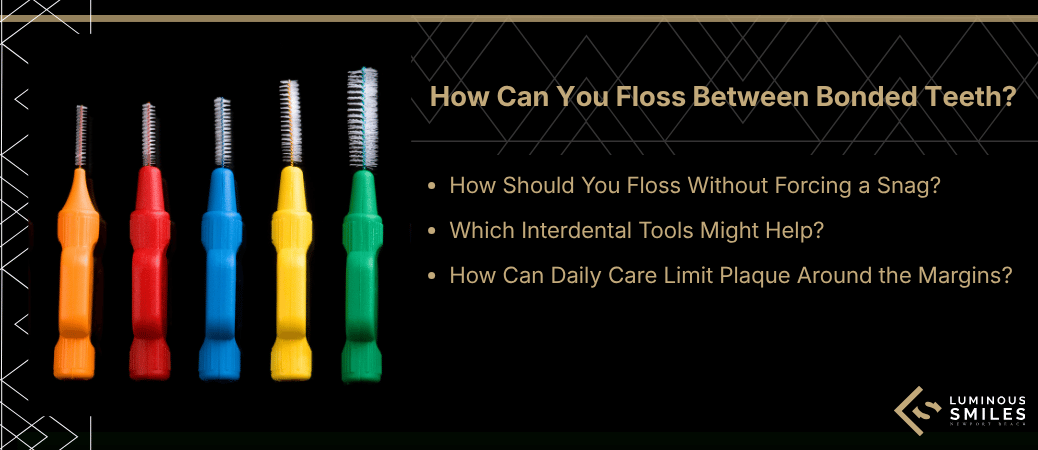
How Should You Floss Without Forcing a Snag?
Slide floss into the gap gently rather than snapping it down between your teeth.
Curve it into a C-shape around each tooth and move it up and down against the surface instead of sawing back and forth, which puts less strain on the bonding margin.
If floss catches, ease it out sideways rather than yanking it back the way it came. Forcing a snagged strand through can fray the floss and put unnecessary pressure on a rough edge.
Which Interdental Tools Might Help?
Waxed dental floss tends to glide more smoothly over small surface irregularities than unwaxed varieties, since the coating helps it slip past minor roughness instead of catching on it.
Floss picks and interdental brushes can be useful where traditional floss keeps snagging in the same place, offering a more predictable path around the bonded area.
Water flossers clean around irregular contours without the mechanical friction that triggers snags in the first place, which makes them a solid option if floss consistently gives you trouble around one spot.
None of these tools need to replace daily brushing, just complement it.
How Can Daily Care Limit Plaque Around the Margins?
Plaque builds up at bonding margins the same way it does anywhere else in your mouth, so consistent daily cleaning matters as much here as on your natural teeth.
Brush twice a day with fluoride toothpaste, choosing a non-abrasive formula so you’re not gradually dulling the composite surface.
The NHS guidance on looking after your teeth and gums recommends daily flossing or interdental cleaning alongside twice-daily brushing, which applies just as much around bonded teeth as natural ones.
Skipping interdental cleaning to avoid a snag tends to backfire, since that allows plaque accumulation right at the margin where bonding is already more vulnerable.
For more on keeping the tissue around any restoration healthy, see this guide on maintaining healthy gums.
When Should a Dentist Check the Bonding?
Book a professional dental assessment if floss keeps catching or shredding in the same spot, if an edge feels sharp against your tongue or lip, or if the gum beside the bonding looks inflamed.
These aren’t emergencies, but they’re also not something to just live with indefinitely.
Which Symptoms Call for a Professional Review?
Persistent gum irritation or bleeding confined to one bonded tooth is one of the clearer signs something needs a look.
So is a visible chip, a noticeably rough patch you can feel with your fingernail, or food that keeps trapping in the same space no matter how carefully you clean.
Sensitivity that’s getting worse rather than better, or a bite that suddenly feels high or uneven on the bonded tooth, also belongs on this list.
Any of these is worth a phone call rather than weeks of working around the problem.
How Might a Dentist Assess and Smooth the Area?
A dentist examines the bonded tooth, checks the margin with a probe and often with floss, and confirms whether the issue is a simple finishing gap or something that needs repair.
Many rough spots are corrected with professional polishing, which removes a thin surface layer and restores a smooth contour in a short appointment.
If there’s excess material or a genuine overhang, your dentist trims and re-polishes that area specifically.
Regular dental examinations and hygiene appointments, scheduled according to your needs, help identify wear or margin problems. Arrange an earlier review if floss repeatedly catches.
A dental examination helps your dentist assess the bonded tooth, its margins, and your bite before recommending polishing or repair.
Keep Flossing Gentle and Have Persistent Snags Checked
A snag on new bonding is usually just your mouth adjusting to a new shape, and most of that awareness fades within a couple of weeks.
A snag that repeats in the same place, shreds floss, or shows up suddenly on older bonding is a different story and deserves a professional look rather than home adjustment.
Keep flossing gently, choose waxed floss or an interdental tool if one spot keeps giving you trouble, and don’t skip cleaning out of worry that you’ll damage the restoration.
If the same edge keeps catching after a few weeks, get it checked at Luminous Smiles so it can be smoothed before it turns into a bigger issue.
Frequently Asked Questions
Can flossing pull off composite bonding?
Gentle, proper flossing technique is very unlikely to pull off well-placed composite bonding.
Forcing floss through a snagged edge or yanking it back out can stress a weak or already-loose margin, so ease it out sideways if it catches instead of pulling hard.
Why does floss shred in the same spot every time?
Floss shredding repeatedly in one location usually means there’s a sharp edge or rough patch on the bonding right at that spot.
This is a common, straightforward finding at a dental review and is often resolved with professional polishing in a short appointment.
Should new composite bonding catch on floss?
Some initial catching on new bonding can happen as you adjust to its new contour, and mild texture is common in the first couple of weeks.
If catching is severe, shreds floss consistently, or doesn’t ease up after a few weeks, it’s worth having checked rather than assumed to be normal.
Will a rough bonding edge smooth out on its own?
A genuinely rough edge or finishing gap does not reliably smooth out by itself and usually needs a dentist’s polish to correct.
What does settle on its own is your tongue’s heightened awareness of the new shape, which is a different thing from an actual rough surface.
Can I use a water flosser instead of string floss around bonding?
A water flosser can clean effectively around irregular contours without the mechanical catching that triggers snags with string floss.
It works well as a supplement or alternative when one spot keeps giving you trouble, though string floss or an interdental brush still reaches some areas a water flosser may miss.